

The number nobody had seen before
23.3%. In people with type 2 diabetes. At 48 weeks.
If you have been following this series, you know the thread I keep pulling: every GLP-1-based molecule loses a chunk of its weight-loss effect the moment the trial population has diabetes. Semaglutide, tirzepatide, retatrutide, CagriSema — the pattern held across all of them. People with T2D lose less, and nobody fully knows why.
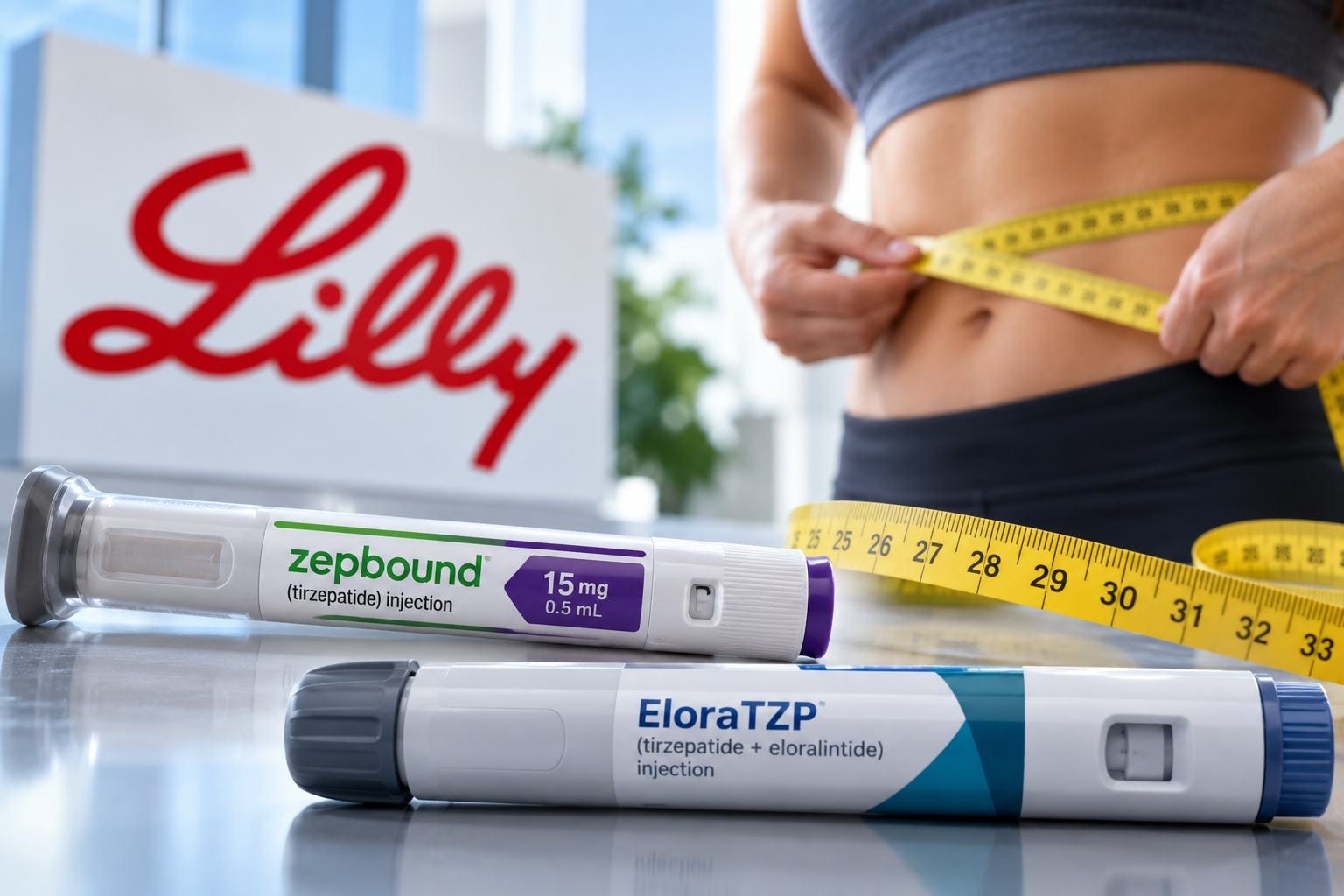
On 30 September, in a symposium room in Milan, Lilly presented a Phase 2b trial in which a diabetic cohort lost as much weight as non-diabetic cohorts do on today’s best drugs. The product is called EloraTZP. It is not one molecule. It is two: eloralintide, Lilly’s selective amylin receptor agonist, stacked on top of tirzepatide.
A note on names before we go further, because I have seen this one mangled already. “Elora” is not a drug. Eloralintide is the amylin agonist, in Phase 3 on its own. EloraTZP is the combination with tirzepatide (TZP), and that is what this article is about.
Three hormones, two needles
Everyone in this field is now riding the amylin wave, and I wrote about why in the amylin piece a fortnight ago. But there are three different ways to ride it, and they are not interchangeable.
Novo’s CagriSema is amylin plus GLP-1 (cagrilintide plus semaglutide), two molecules co-formulated in one pen. Novo’s zenagamtide, formerly amycretin, is amylin plus GLP-1 in a single molecule. EloraTZP is the first to put amylin on top of a dual incretin: tirzepatide already activates GIP and GLP-1, so the combination hits three nutrient-stimulated hormone receptors at once. Retatrutide also hits three, but its third is glucagon, and it does it with one molecule.
Lilly’s logic, in the words of Rachel Batterham, now the company’s SVP of medical innovation: GLP-1, GIP and glucagon are incretins with a broadly similar mechanism, while amylin acts through a separate receptor and a separate pathway, so the effects should be additive rather than overlapping. Amylin is co-secreted with insulin from the beta cell, slows gastric emptying and signals satiety through the hindbrain. It is the hormone that, in theory, should get you a different kind of weight loss rather than more of the same.
One practical detail that matters for the rest of this article: in Phase 2b, EloraTZP was given as two separate weekly injections. Lilly says the Phase 3 product will be a single co-formulation. That co-formulated product has not been dosed in a single patient yet.
The trial
NCT06603571 is a 48-week, double-blind, placebo-controlled Phase 2b study in 367 adults with obesity or overweight and type 2 diabetes, run in the US and Argentina. Baseline body weight was 105.4 kg and baseline A1C 8.1%. Ten arms: placebo; eloralintide alone at 3, 6 or 9 mg; tirzepatide alone at 15 mg; four EloraTZP combinations (3+5, 6+5, 6+10 and 9+15 mg); and an arm that ran tirzepatide 15 mg for 24 weeks and then added eloralintide for the remaining 24. Lead author was Liana Billings of Endeavor Health, who also led the eloralintide monotherapy Lancet paper. The primary endpoint was percent change in body weight for EloraTZP versus placebo.
Weight at 48 weeks, efficacy estimand: the top combination, eloralintide 9 mg plus tirzepatide 15 mg, lost 23.3%, or 54 lb. The 6+10 mg arm lost 19.9%, the 6+5 mg arm 19.4%, the 3+5 mg arm 13.2%. Tirzepatide 15 mg alone lost 14.8%. Eloralintide alone lost between 8.2% and 12.3%. Placebo lost 3.0%. The add-on arm, tirzepatide first and eloralintide from week 24, finished at 19.9%.
Two things I want you to notice in those numbers. Eloralintide 6 mg plus tirzepatide 5 mg, the lowest maintenance dose of tirzepatide, beat tirzepatide 15 mg by almost five points. And the add-on arm reached the same place as the 6+10 arm with only 24 weeks of amylin exposure. We will come back to both.
A1C: minus 2.9 percentage points on the top combination, minus 2.4 on tirzepatide alone, minus 0.3 on placebo. At least 90% of patients in every combination arm reached an A1C below 7%, and 77% of the top-dose arm reached below 5.7%. That is not controlled diabetes. That is a normal A1C. Responder rates, per Billings’ presentation: 63% of the 9+15 mg arm lost at least 20% of their body weight and 25% lost at least 30%. Her own summary line: “We have not seen these degrees of weight loss in people with type 2 diabetes in previous studies.” I have checked. She is right.
The diabetes gap, revisited
This is the thread I have been pulling since the first retatrutide article, so let me lay the numbers side by side. All of these are diabetic cohorts, all are the efficacy estimand, and none of them are head-to-head, so treat the comparison as a map, not a verdict.
Tirzepatide 15 mg in SURMOUNT-2 lost 14.7% at 72 weeks; the tirzepatide arm inside this very trial lost 14.8% at 48 weeks, which is reassuring about the population. Retatrutide 12 mg in TRIUMPH-2 lost 20.8% at 80 weeks. CagriSema in REDEFINE 2 lost 15.7% at 68 weeks, and in REIMAGINE 5, announced on 21 September, the 1.0/1.0 mg dose lost 12.4% against 9.1% on tirzepatide 5 mg, a comparator dose I will leave you to judge. EloraTZP 9+15 mg lost 23.3% at 48 weeks.
For context, the non-diabetic numbers for the same molecules: tirzepatide 15 mg lost 20.9% in SURMOUNT-1, retatrutide 12 mg 22.6% in TRIUMPH-1, CagriSema 22.7% in REDEFINE 1. In other words, EloraTZP in people with diabetes landed where the best current drugs land in people without it.
Why would adding amylin close a gap that GIP, GLP-1 and glucagon could not? Nobody knows yet, and anyone who tells you they do is selling something. The honest hypotheses: amylin’s satiety signal does not run through the same insulin-resistant machinery; the gastric-emptying effect is additive; or the diabetic cohort in this trial simply responded unusually well, which with arms of 36 patients is not a hypothesis you can dismiss. Phase 3 will tell us. Until then, the gap has closed in one trial, and that is already more than any other molecule has managed.
Read the confidence intervals. Except you can’t.
Here is where the pharmacist in me hands over to the ex-CRA.
Every number above is the efficacy estimand. Lilly’s own footnote defines it as the effect “had all randomized participants remained on study intervention for 48 weeks.” It is the answer to “what does the drug do if you take it,” not “what happens to the people we randomised.” The treatment-regimen estimand, which counts the dropouts, was not released. And in this trial the dropouts matter, as the next section explains.
How big can the difference be? We have a clue from eloralintide monotherapy. In the Lancet Phase 2, the 9 mg arm lost 20.1% on the efficacy estimand and 17.5% on the treatment-regimen estimand, a gap of 2.6 points, with placebo moving from minus 0.4% to minus 2.3%. If EloraTZP’s gap is similar, the real-world number is closer to 20% than 23%. Still unprecedented in diabetes. But a different headline.
Second: no confidence intervals have been published for any arm of this trial. Not in the press release, not in the conference coverage. With 367 patients across ten arms, each arm holds roughly 36 people, so one patient is nearly three percentage points of any proportion you read. A 63% responder rate at 20% weight loss is about 23 people. The Lancet monotherapy paper, for comparison, gave the 9 mg arm a 95% CI of minus 22.7 to minus 17.5. I would expect EloraTZP’s interval to be at least that wide, and I will update this article when the full publication lands.
Third, and this is a small correction I want to make in public: one of the trade write-ups reports that discontinuation due to adverse events was “under 10% in all arms.” Lilly’s own release says 10.8% to 27.0% in the combination arms. I am going with the sponsor’s number, and it is not a flattering one.
The price of stacking
The whole pitch for amylin agonists has been tolerability. Eloralintide on its own looked gentle: in the Lancet study, treatment-emergent adverse events were 81% on drug and 79% on placebo, serious adverse events 5.3% versus 5.4%, and the slow 3-to-6-to-9 mg escalation arm had GI rates similar to placebo. Petrelintide, Roche’s amylin, reported placebo-like GI rates at EASD and zero vomiting at its best dose.
Stack that gentle molecule on tirzepatide and the gentleness goes. Discontinuation due to adverse events ran from 10.8% to 27.0% across the EloraTZP arms, against 2.9% on tirzepatide alone and 0% to 10.8% on eloralintide alone. GI events were more frequent on the combination than on either drug by itself. Nausea, vomiting and fatigue were all higher in the 9+15 mg arm than on tirzepatide 15 mg.
Billings’ explanation is that both drugs were started and escalated at the same time, and the trial’s own design supports her: the add-on arm, where eloralintide came in at week 24 on top of established tirzepatide, had adverse-event rates similar to tirzepatide alone and still reached 19.9%. That is why Lilly is talking about an “optimized escalation schedule” for Phase 3. It is also, if you read it the other way, an admission that the Phase 2b titration was wrong.
Now the placebo arm, because this is a clinical-research newsletter and I cannot let it go. Placebo lost 3.0% at 48 weeks and had a 16.7% discontinuation rate due to adverse events. Sixteen point seven percent. On saline. Six of roughly 36 people stopped a placebo for side effects. I have a whole article coming on how obesity trials are breaking their placebo arms: patients can tell within weeks whether they have drug, they leave, and the comparator stops behaving like a comparator. This trial is a textbook case, and it should make every CRA reading this ask what the dropout pattern looked like by week 12.
Why eloralintide and not cagrilintide
If you read the amylin article, you know the class splits in two. Cagrilintide is a dual amylin and calcitonin receptor agonist, a DACRA. Eloralintide is sold as selective: designed to preferentially activate the amylin-1 receptor with minimal calcitonin receptor activity. Lilly’s medical-information page gives the binding numbers. In human receptor assays, eloralintide binds AMY1R about 8-fold more tightly than the calcitonin receptor; cagrilintide manages about 2.5-fold. In rat assays the difference is dramatic, 109-fold versus 1.2.
The claim built on top of that is that selectivity means better GI tolerability. The evidence for the claim is rat data, and Lilly says so itself, in a sentence I want to quote exactly: “Further research is needed to determine the functional significance of selectivity in humans.”
So here is the evidence-nerd’s problem. Eloralintide alone does look well tolerated. But the moment it is stacked on tirzepatide, discontinuations for adverse events run up to 27%, almost ten times the tirzepatide-alone arm in the same trial. Either selectivity buys you nothing once a potent incretin is on board, or the simultaneous titration drowned the signal. The add-on arm suggests the second. Phase 3, with its new escalation schedule, is the experiment that decides it, and it is the single most important thing to watch in this programme.
One more data point, for completeness. Billings reported in the monotherapy study that 60 to 70% of the weight lost on eloralintide was fat mass. No body-composition data have been released for EloraTZP. Given how much of my inbox is about muscle, I will be watching for the DXA substudy.
What Phase 3 has to prove
Lilly says Phase 3 of a co-formulated EloraTZP starts by the end of 2026, in both obesity and type 2 diabetes. Eloralintide monotherapy is already in Phase 3 under the ENLIGHTEN programme, including ENLIGHTEN-3 in obstructive sleep apnoea, 800 patients over 76 weeks. Lilly reports Q3 earnings on 29 October, and I would expect trial names and timelines there.
Three things Phase 3 has to show. First, that the co-formulation behaves like the two separate injections, because a new formulation is a new product with its own PK bridging, its own stability package and its own injection-site profile. Second, that the new escalation schedule brings discontinuations down to tirzepatide territory without giving back the efficacy, which the add-on arm hints is possible. Third, that the diabetes result holds in a thousand people rather than thirty-six.
The competitive map, as of this week. Novo’s CagriSema is at the FDA for weight management with a decision expected this quarter, and REDEFINE 4 is a head-to-head against Zepbound 15 mg in 800 patients over 72 weeks. Roche and Zealand’s petrelintide is in Phase 3 after 10.7% at 42 weeks with placebo-like tolerability. AbbVie’s ABBV-295 showed 7.9% in about 12 weeks with monthly dosing and is heading to Phase 2. Zenagamtide had no new efficacy readout at EASD. And every one of these companies is now being asked the same question by investors: what can your molecule be combined with?
That is the real signal from Milan. A GLP-1 on its own is no longer a differentiated asset. The industry has moved from “which hormone” to “which stack,” and the trials of the next five years will be designed accordingly.
Three ways to read this
The researcher in me says: ten arms of 36 patients, no confidence intervals, no treatment-regimen estimand, a placebo arm that lost a sixth of its patients to side effects, and a Phase 3 product that is not the Phase 2 product. This is a hypothesis-generating trial that generated a very good hypothesis. Design the Phase 3 well, with an estimand strategy agreed before unblinding, and let the data speak.
The pharmacist in me says: a diabetic patient reaching a normal A1C and losing a fifth of their body weight on one product is a different conversation in the pharmacy. And the add-on arm is clinically the most useful result in the whole trial, because that is how real patients will meet this drug: already on tirzepatide, plateaued, asking what’s next. Starting the amylin later, on an established incretin, looks like the way to do it.
The evidence nerd in me says: the diabetes gap was the most interesting unexplained finding in this whole class, and the first molecule to close it did so by adding a hormone that is not an incretin. That is not a coincidence. That is biology telling us something about why people with diabetes respond differently, and someone is going to write a very good mechanistic paper about it. I hope they read the confidence intervals first.
This is metabolic medicine’s moment. And it’s just getting started. ✌️
Key References
Eli Lilly. Lilly’s EloraTZP delivered greater weight loss and A1C reduction vs. tirzepatide 15 mg in adults with obesity and type 2 diabetes. Press release, 30 September 2026. NCT06603571.
Healio. Combining amylin agonist with tirzepatide leads to further weight loss in type 2 diabetes. Billings LK, EASD 2026 session S21, reported 2 October 2026.
HCPLive. EASD 2026: EloraTZP bests tirzepatide on weight loss, A1C in type 2 diabetes. 30 September 2026.
Billings LK, Hsia S, Bays H, et al. Eloralintide, a selective amylin receptor agonist for the treatment of obesity: a 48-week phase 2, multicentre, double-blind, randomised, placebo-controlled trial. Lancet, published online 6 November 2025. DOI 10.1016/S0140-6736(25)02155-5. Coverage: HCPLive, Healio.
Eli Lilly. Lilly’s selective amylin agonist, eloralintide, demonstrated meaningful weight loss and favorable tolerability in a Phase 2 study. 6 November 2025.
Lilly Medical. Is eloralintide a selective amylin receptor agonist? Receptor binding data, eloralintide vs cagrilintide.
Eli Lilly. What to know about eloralintide. 30 September 2026.
Eli Lilly. Lilly to present new data on Foundayo, retatrutide and eloraTZP at EASD 2026. 15 September 2026.
Drug Discovery News. Lilly’s amylin combo raises the bar, and the stakes, for obesity drug developers.
Healio. Retatrutide induces significant weight loss in type 2 diabetes. TRIUMPH-2 topline.
Pharmacy Times. CagriSema tops tirzepatide 5 mg for weight loss in REIMAGINE 5. 28 September 2026.
Fierce Pharma. Novo Nordisk fights back at Lilly with Wegovy combo trial against Zepbound. REDEFINE 4, NCT06131437.
Obesity Medicine Visuals. EASD 2026 obesity medicine roundup. Petrelintide, ABBV-295, zenagamtide.
ENLIGHTEN-3, NCT07369011. Eloralintide in obstructive sleep apnoea.
Jastreboff AM et al. Tirzepatide once weekly for the treatment of obesity. N Engl J Med 2022 (SURMOUNT-1); Garvey WT et al. Tirzepatide once weekly for the treatment of obesity in people with type 2 diabetes. Lancet 2023 (SURMOUNT-2).
Eloralintide and EloraTZP are investigational and are not approved by any regulatory authority. CagriSema, zenagamtide, petrelintide, ABBV-295 and retatrutide are investigational. Nothing in this article is medical advice. All cross-trial comparisons are indirect and are offered for context only.