

From kilograms to years
Yesterday I posted a slide from the XXI National Symposium on Endocrinology in Plovdiv. (you can see the post here). It showed a Nature paper in which semaglutide, started in old age, extended the median lifespan of female mice by 12%.
It is mice. It is females only. And the study had no calorie-restricted group in its lifespan arm, so nobody can yet separate the drug from the smaller dinner.
What stayed with me was not the slide. It was the room.
In the first ten days of October I sat in two Bulgarian congress halls: the 17th National Scientific-Practical Conference on General Medicine in Albena, and the endocrinology symposium in Plovdiv. In both, the conversation had moved on from weight loss. It was about lifelong therapy, and what a person gains by staying on it for decades.
The companies are choosing their words very carefully. They are rebranding, quietly, from weight-loss manufacturers into something closer to healthy-ageing companies.
My own prediction, and I will own it if I am wrong: in the future we will all be on something.
If that is where we are going, the question changes. It stops being “which drug takes off the most weight” and becomes “which drug can a person stay on for thirty years”. That second question is why the whole industry just bet on a hormone called amylin.
If we will all be on something, what does that something need?
The human evidence that these drugs do more than shrink waistlines already exists, and it is the real bridge from weight-loss drug to longevity drug.
In SELECT, 17,604 people with overweight or obesity and cardiovascular disease, but no diabetes, took semaglutide or placebo for a mean of 40 months. Major cardiovascular events fell by 20% (HR 0.80, 95% CI 0.72–0.90). Deaths from any cause were lower too (HR 0.81, 95% CI 0.71–0.93).
Read the confidence intervals, though. Cardiovascular death on its own did not reach significance (HR 0.85, 95% CI 0.71–1.01). The all-cause number is a signal to follow, not a proven life extension.
Still, once the conversation moves from kilograms to years of life, the treatment horizon moves with it. We stop talking about a 68-week trial and start talking about thirty years of therapy. I have argued before that obesity is chronic, relapsing and progressive, and that people will be on and off these medicines for the rest of their lives. My last article was about what happens when you stop.
A drug you take for decades has a harder job than a drug you take for a year. I think it needs four things.
Tolerability you can live with for years. Nausea that is acceptable for a 16-week escalation is not acceptable as a way of life.
A second mechanism. When the first one plateaus, or stops being tolerated, there has to be somewhere to go that is not simply a higher dose.
Weight loss worth keeping. I have said that some muscle loss is expected and fine. Over thirty years, the balance of fat and muscle still deserves better data than we have.
Convenience. One pen, not two. Weekly now, monthly later.
GLP-1 alone does not answer all four. That is why Novo Nordisk , Eli Lilly and Company, Roche and Zealand Pharma have all put serious money on the same second hormone.
Amylin: the hormone that waited decades
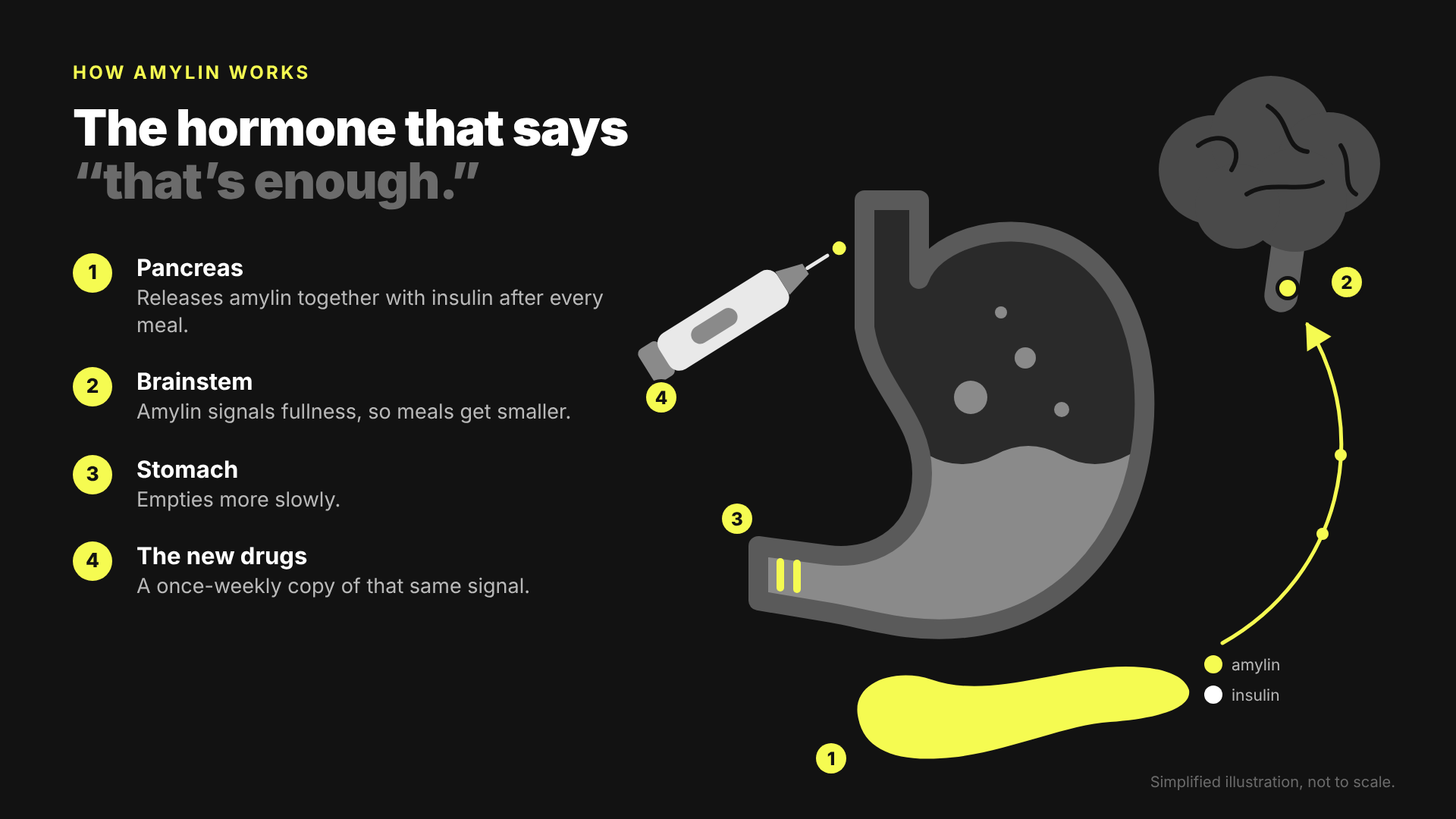
Amylin is the fullness hormone your pancreas releases together with insulin every time you eat. The same beta cells make both, with amylin at roughly 2–5% of the amount of insulin (review, 2024).
It does three things after a meal.
It tells the brainstem you have had enough, mainly through a region called the area postrema, so meals get smaller.
It slows the emptying of the stomach.
It suppresses glucagon after the meal.
Notice what is different from GLP-1. Amylin signals through its own receptor, a calcitonin receptor paired with helper proteins. That is the whole point: a second route to fullness that does not depend on pushing the GLP-1 receptor harder.
None of this is new. A short-acting amylin analogue, pramlintide, was developed in the 1990s for people with diabetes on insulin. It had to be injected before every meal, so it never became a mainstream medicine.
What changed is chemistry. The new analogues last a week, and they are stable enough to share a pen with another peptide. Animal studies also suggest amylin raises energy expenditure, though the same review is clear that human data are limited.
The bets: four companies, one hormone
The biggest names in obesity now each have an amylin programme, and three of them have reported new data since mid-September.
Molecule
Company
What it is
Stage
Headline weight loss
CagriSema (cagrilintide + semaglutide)
Novo Nordisk
Amylin and calcitonin receptor agonist plus GLP-1, weekly
FDA decision expected Q4 2026
21.0% at 68 weeks on the lower 1.0/1.0 mg dose (REDEFINE 9)
Lilly
Selective amylin receptor agonist, weekly
Phase 3
20.1% at 48 weeks, no diabetes (Phase 2)
EloraTZP (eloralintide + tirzepatide)
Lilly
Amylin plus GIP/GLP-1, weekly
Phase 3 starts Q4 2026
23.3% at 48 weeks, type 2 diabetes (Phase 2b)
Zealand Pharma and Roche
Long-acting amylin analogue, weekly
Phase 3
10.7% at 42 weeks, no diabetes (Phase 2)
Zenagamtide (formerly amycretin)
Novo Nordisk
One molecule that activates both GLP-1 and amylin receptors
Phase 3 in type 2 diabetes planned for H2 2026
14.6% at 36 weeks, type 2 diabetes (Phase 2)
All figures are the efficacy estimand unless I say otherwise. These are different trials, doses, durations and populations, so the column is a map and not a ranking.
Novo Nordisk: first to the regulator, after a bruising year
CagriSema will be the first amylin-containing obesity medicine to reach an FDA decision. It did not get there smoothly.
REDEFINE 1 delivered 22.7% at 68 weeks if everyone stayed on treatment, and 20.4% regardless of adherence. Cagrilintide alone gave 11.8% and semaglutide alone 16.1%. Then REDEFINE 4 put the full 2.4/2.4 mg dose against tirzepatide 15 mg and missed non-inferiority: 23.0% against 25.5%.
September changed the story. On the lower 1.0/1.0 mg dose, CagriSema reached 21.0% at 68 weeks in REDEFINE 9. In REIMAGINE 5 the same low dose beat tirzepatide 5 mg in type 2 diabetes, 12.4% against 9.1% at 60 weeks. If less than half the dose gets you most of the effect, the pitch stops being “the strongest” and becomes “the one you can stay on”.
Lilly: the selective one, and the biggest number in diabetes
Eloralintide is built to hit the amylin receptor selectively. In its Phase 2 trial, 263 people without diabetes lost up to 20.1% at 48 weeks on the 9 mg dose, against 0.4% on placebo. That is amylin on its own, without any GLP-1.
Then came EASD. EloraTZP pairs eloralintide with tirzepatide, and in 367 people with type 2 diabetes the top dose produced 23.3% weight loss at 48 weeks. Tirzepatide 15 mg alone gave 14.8%. HbA1c fell by 2.9 points.
Roche and Zealand: the gentle one
Petrelintide is the tolerability bet. In ZUPREME-1, published in The Lancet Diabetes & Endocrinology on 29 September, 485 people lost up to 10.7% at 42 weeks. The three highest doses landed in almost the same place, so the effect looks like it plateaus near 10%.
The side-effect profile is the headline. Nausea affected 20% against 6% on placebo, only 1.5% stopped because of gut side effects, and more people withdrew from placebo than from the drug (13.6% against 8.4%). Roche plans to combine it with its own incretin.
And amycretin?
I covered amycretin in June (you can see the article here). It now has a proper name, zenagamtide, and it takes the opposite engineering approach: one molecule that activates both receptors, where the others combine two molecules in one pen. Same bet, different build.
Read the confidence intervals
The amylin story is promising and unfinished, and five things in the data keep me from calling it more than that.
1. Almost every headline is the efficacy estimand. That is the number you get if everyone stays on the drug. Where we have both, the gap is real: in REDEFINE 4, CagriSema’s 23.0% becomes 20.2% once you count everyone regardless of adherence. For EloraTZP we only have the efficacy figure so far, and no journal paper.
2. People are stopping. In the EloraTZP trial, 10.8% to 27.0% of people in the combination arms discontinued because of adverse events. On tirzepatide alone it was 2.9%. A drug that up to 27% of people abandon within 48 weeks is not yet a drug for thirty years. Lilly says Phase 3 will use an optimised dose escalation, and that schedule will decide the product.
3. The placebo arm lost 16.7% to adverse events. That is more than five times the tirzepatide arm, in the same trial. I do not have an explanation, and I want to see the paper. Obesity trials have a placebo problem, and it deserves its own article.
4. The type 2 diabetes gap is still here. My running thread. In its two Phase 3 papers, CagriSema gave 20.4% without diabetes and 13.7% with it. Eloralintide alone gave 20.1% without diabetes and 8.2% to 12.3% with it. That is what makes EloraTZP’s 23.3% in a diabetes population so striking. For context, retatrutide reached 20.8% at 80 weeks in TRIUMPH-2. But EloraTZP is a Phase 2b with 367 people spread over nine arms. Small arms give wide intervals.
5. Comparator doses are a choice. CagriSema lost to tirzepatide 15 mg and beat tirzepatide 5 mg. Both results are true. Only one of them is the comparison a prescriber cares about.
And the biggest gap of all, given where this article started: nobody has shown that amylin changes outcomes. There is no cardiovascular outcomes result and no survival signal. Even the claim of better-quality weight loss is unproven; Roche lists body composition as an exploratory endpoint and has not reported it. The mouse that lived 92 days longer was on semaglutide, not amylin.
What to watch before the end of the year
The next three months will tell us whether amylin becomes a prescribable class or stays a pipeline slide.
CagriSema FDA decision. Novo guides to Q4 2026. No date has been made public, so it could land any week.
EloraTZP Phase 3. Lilly plans to start in Q4 2026 with a single co-formulated pen. Watch the escalation schedule.
Petrelintide in type 2 diabetes. ZUPREME-2 topline is due in the second half of 2026.
Zenagamtide. Novo plans to start Phase 3 in type 2 diabetes in the second half of 2026.
ObesityWeek, 14–17 November. The next stage for full datasets.
If CagriSema is approved, read the label for two things: which doses are included, and what it says about people with type 2 diabetes.
My take, in three voices
The researcher in me sees a class whose Phase 3 success will be decided by titration, not by potency. If you are a CRA or a site coordinator on one of these studies, expect longer escalation, more dose-modification visits, and a placebo arm that is hard to keep. Retention is the endpoint behind the endpoint.
The pharmacist in me cares about the drug a person can still be taking in year five. Petrelintide’s 10% with very little nausea may matter more to real patients than a 23% that came with up to 27% of an arm stopping for side effects. One pen instead of two matters as well. The EloraTZP Phase 2 used two separate injections.
The evidence nerd in me has to say it plainly: the longevity data are early. A 12% lifespan gain in a study of 79 female mice. A mortality signal in SELECT that was not the primary endpoint. Nothing yet for amylin. Those are the facts, and I will keep reporting them as they change.
And I am still all in. We already medicate people who feel perfectly healthy, and we call it prevention: a statin before the heart attack, a blood-pressure tablet before the stroke. Metabolic drugs belong on that list. I would rather treat the biology early than wait for the diagnosis.
So yes, I stand by my prediction that most of us will end up on something. Amylin is the industry’s plan for making that something easy enough to live with for a lifetime.✌️
Key references
Feng Y, et al. Late-life semaglutide treatment slows ageing and extends lifespan in female mice. Nature 2026;657:469–476. doi:10.1038/s41586-026-10940-7
American College of Cardiology. SELECT trial summary.
Amylin, another important neuroendocrine hormone for the treatment of diabesity. Int J Mol Sci 2024;25(3). PMC10855385
Novo Nordisk. CagriSema delivers superior weight loss versus tirzepatide in REIMAGINE 5. 21 September 2026.
Novo Nordisk. REDEFINE 1 topline results. 20 December 2024.
American College of Cardiology. REDEFINE 1 and REDEFINE 2, summarising the NEJM papers of 22 June 2025.
Novo Nordisk. REDEFINE 4 results. 23 February 2026.
Eli Lilly. Eloralintide Phase 2 results. 6 November 2025.
Eli Lilly. EloraTZP Phase 2b results. 30 September 2026.
HCPLive. EloraTZP bests tirzepatide on weight loss, A1C in type 2 diabetes. 30 September 2026.
Roche. Positive Phase II results for petrelintide. 5 March 2026.
Medical Daily. Lancet publishes full petrelintide trial. 1 October 2026.
Novo Nordisk. Zenagamtide Phase 2 results in type 2 diabetes. 5 June 2026.
Eli Lilly. Retatrutide TRIUMPH-2 results. 29 September 2026.
CagriSema, cagrilintide, eloralintide, EloraTZP, petrelintide, zenagamtide and retatrutide are investigational medicines. They are not approved for any use, and their safety and efficacy have not been established. This article is for information and discussion among professionals and is not medical advice.